The Cinchona Bark, the Fever, and the Self-Experiment of 1790
Hahnemann's 1796 self-administration of Peruvian bark and its place in the formation of similia similibus curentur — drawn from his own account in the Hufeland's Journal paper of that year. The origin story of the system, dated and sourced.
Division 22, Père Lachaise.Photo: Raylarında Şehrin / Pexels
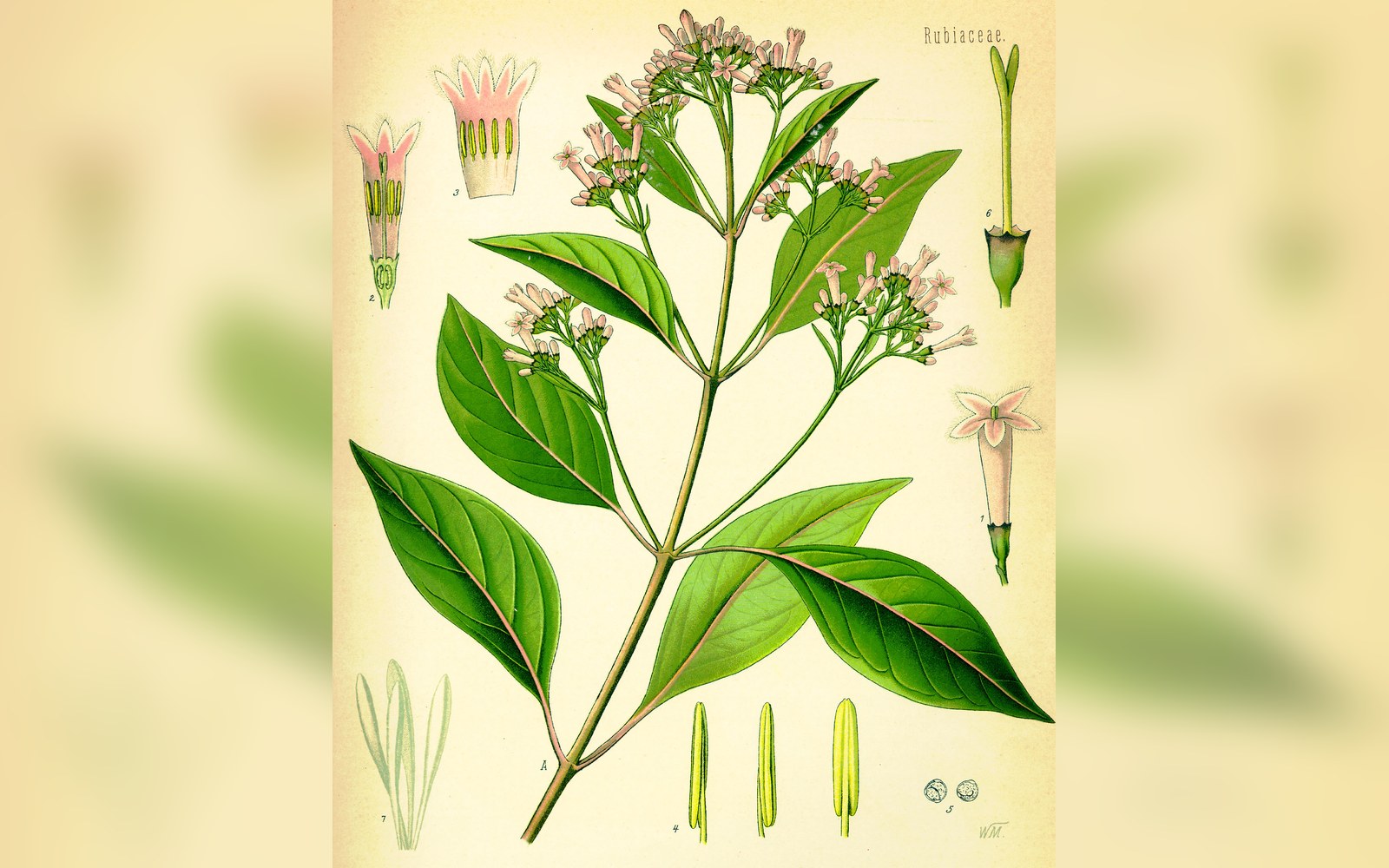
Cinchona officinalis. Hahnemann took Peruvian bark himself and wrote down what followed.Photo: Cinchona officinalis (Köhler) · Wikimedia Commons
A physician ingests Peruvian bark, records his symptoms, and draws a conclusion that founds a system.
The Experiment and the Reasoning
In 1790, while translating William Cullen's A Treatise on the Materia Medica into German, Samuel Hahnemann paused at Cullen's explanation of why cinchona bark — Peruvian bark, the source of quinine — reduces intermittent fever. Cullen attributed the effect to the bark's bitterness and astringency acting on the stomach. Hahnemann found the explanation unconvincing and took the uncommon step of testing the substance on himself.

The first edition, Dresden, 1810. Hahnemann set out the centesimal method in its passages on preparation and revised them in every edition after.Photo: Marta Branco / Pexels
Over several days he ingested doses of cinchona and recorded what followed: cold extremities, heart palpitations, throbbing in the head, drowsiness, anxiety. The symptoms, he noted, resembled those of intermittent fever itself. The observation crystallised into a proposition: a substance capable of producing a set of symptoms in a healthy person might, by that very capacity, address those same symptoms when they arise from disease. He called the principle similia similibus curentur — let likes be cured by likes.
The 1796 Paper in Hufeland's Journal
Hahnemann published his reasoning six years after the cinchona experiment, in 1796, in the Journal der practischen Arzneykunde und Wundarztneykunst — commonly called Hufeland's Journal after its editor Christoph Wilhelm Hufeland ↗, the prominent physician who ran the periodical from its founding in 1795. The paper, "Versuch über ein neues Princip zur Auffindung der Heilkräfte der Arzneisubstanzen" ("Essay on a New Principle for Ascertaining the Curative Powers of Drugs"), set out the like-cures-like principle in its first formal statement.
- 1790Hahnemann translates Cullen's Materia Medica; conducts cinchona self-experiment
- 1795Hufeland's Journal der practischen Arzneykunde founded
- 1796"Essay on a New Principle" published; first formal statement of similia similibus curentur
- 1807Hahnemann first uses the word Homöopathie in print
- 1810Organon der rationellen Heilkunde, first edition, Dresden
The 1796 text does not yet name a system. It does not yet use the word Homöopathie, which Hahnemann would introduce in print in 1807. What it contains is the clinical argument: that the most reliable guide to a substance's curative power is its demonstrated ability to produce analogous symptoms in the healthy, and that existing materia medica, catalogued by crude chemical properties or theoretical mechanism, should instead be reorganised around that criterion. The self-experiment with Peruvian bark is presented as the founding observation from which this follows.
From Observation to Doctrine
The interval between the experiment and the publication matters. Hahnemann spent those six years accumulating further examples — testing substances on himself, on family members, and on small groups of volunteers in the procedure he would later formalise as the proving (Prüfung in German). By 1796 he had enough cases to frame the cinchona observation not as an accident but as an instance of a general rule.
That rule received its full systematic treatment in the Organon der rationellen Heilkunde, first published in Dresden in 1810. The Organon's aphorisms codified proving methodology, the principle of the single remedy, and the doctrine of the minimum dose, but the logical spine of the entire structure runs back to the 1796 paper and, behind that, to the afternoon — the date is not recorded with precision — when Hahnemann swallowed the bark and began writing down what he felt.
The cinchona account also fixes a biographical and intellectual coordinate: Hahnemann in 1790 was thirty-five years old, a qualified physician who had already published on chemistry and medicine, working as a translator because private practice had not satisfied him. The self-experiment was not the act of a novice reaching for novelty; it was a trained observer applying, to his own body, the empirical habit he already used in the laboratory. Whether the symptoms he recorded were pharmacological, idiosyncratic, or artefactual has been debated in the literature ↗ without resolution. What is not disputed is that he recorded them, published them, and built the argument of a system on the record.