30C Written Out
Presents the dilution factor for a 30C preparation — 10⁻⁶⁰ — as worked arithmetic, showing each step of the centesimal series and where Avogadro's limit falls within it.'s limit falls within it. No argument is made; the numbers are the content.
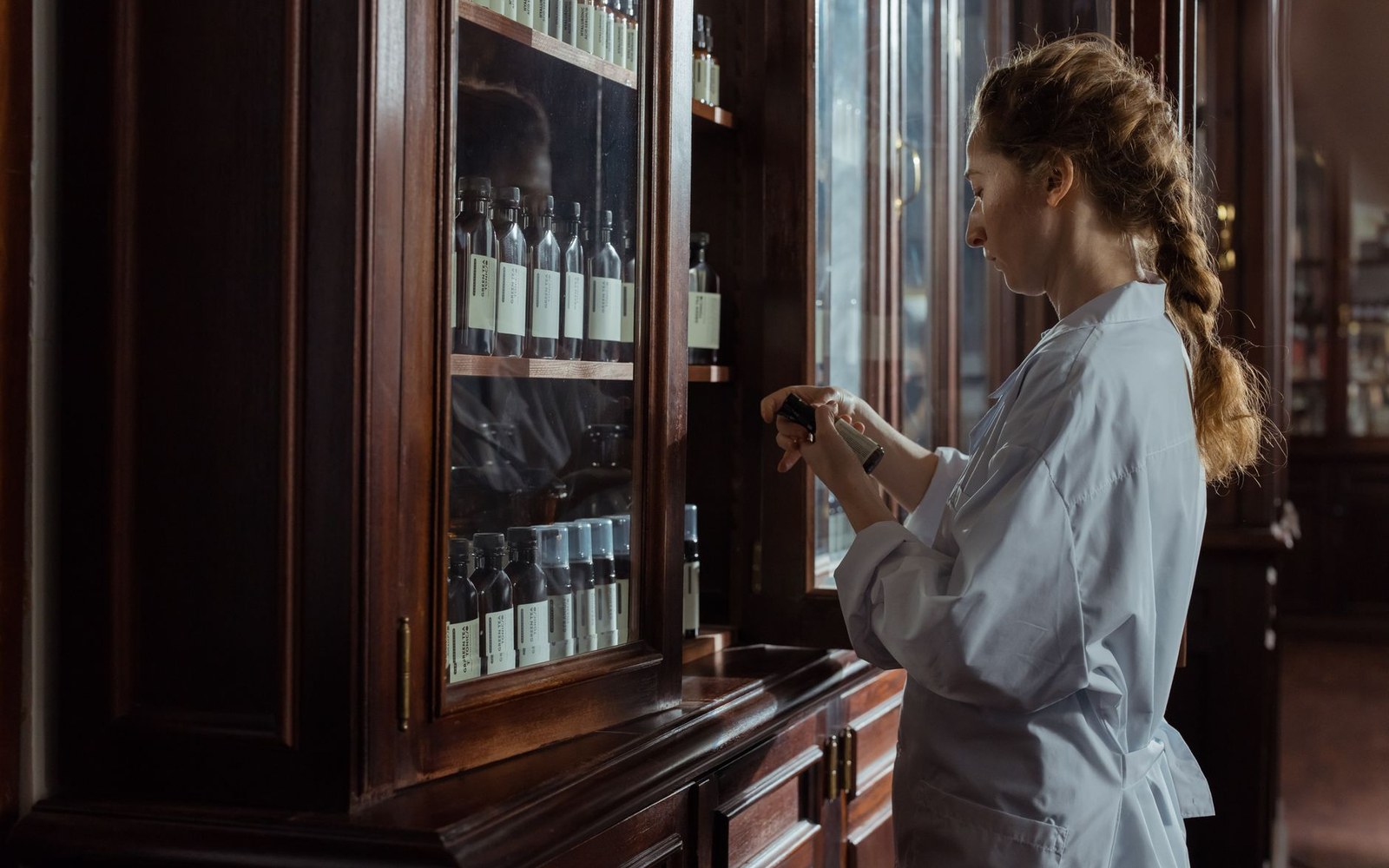
Labelled by remedy and by potency; what is inside each vial is sugar.Photo: cottonbro studio / Pexels

Thirty applications of one ratio. The arithmetic is not disputed by anybody.Photo: MART PRODUCTION / Pexels
The number on the label, computed step by step
A preparation labelled 30C has been through thirty rounds of the centesimal dilution series. Each round takes one part of the previous liquid and adds ninety-nine parts of solvent — water, ethanol, or a mixture — then subjects the vial to succussion. The dilution factor applied at each step is therefore 1 in 100, written as 10⁻². After two steps the cumulative factor is 10⁻⁴. After ten steps, 10⁻²⁰. After thirty steps, 10⁻⁶⁰. That is the figure: a final concentration one part in one followed by sixty zeros.
Where Avogadro's constant enters the series
The arithmetic intersects a second number at around the twelfth centesimal step. Avogadro's number, determined by later chemists to be 6.022 × 10²³, is the count of molecules in one mole of any substance. One mole of a solute dissolved in a litre of solvent represents a concentration of 1 mol/L, a reasonable starting-point for the mother tincture before dilution begins.

Sixty zeros, written out.Photo: https://kaboompics.com/ / Pexels
At a dilution of 10⁻²⁴ — reached at the twelfth centesimal step — the expected number of solute molecules in a litre of preparation falls below one. The precise crossover depends on the starting concentration: a more dilute mother tincture crosses the threshold earlier; a saturated one, a step or two later. The Homeopathic Pharmacopoeia of the United States ↗ specifies starting concentrations for individual substances, and those figures shift the crossover point by at most a few steps. In every realistic case the threshold lies between the tenth and fourteenth centesimal step.
The 30C preparation sits eighteen or more steps beyond that threshold. At 10⁻⁶⁰, the probability that a single molecule of the original solute is present in any given dose — in any given litre, or any given swimming pool, or any given volume the size of the observable universe — is, arithmetically, negligible. One litre of water contains approximately 3.3 × 10²⁵ water molecules; at 10⁻⁶⁰ dilution, the expected count of solute molecules in that litre is 3.3 × 10⁻³⁵, a number that has no physical realisation.
| Step 1C | factor 10⁻² |
| Step 6C | factor 10⁻¹² |
| Step 12C | factor 10⁻²⁴ — Avogadro threshold zone |
| Step 15C | factor 10⁻³⁰ |
| Step 20C | factor 10⁻⁴⁰ |
| Step 30C | factor 10⁻⁶⁰ |
| Step 200C | factor 10⁻⁴⁰⁰ |
| Step 1M (1000C) | factor 10⁻²⁰⁰⁰ |
The thirty steps, set out
The series runs as follows, each entry giving the step number and the cumulative dilution factor:
- 1C → 10⁻²
- 2C → 10⁻⁴
- 6C → 10⁻¹²
- 12C → 10⁻²⁴ (Avogadro threshold zone)
- 15C → 10⁻³⁰
- 20C → 10⁻⁴⁰
- 24C → 10⁻⁴⁸
- 30C → 10⁻⁶⁰
The steps not listed follow the same 10⁻² increment per round. The pattern is strictly linear on a logarithmic scale; there is no inflection, no discontinuity. The Korsakov single-vial method, in which the same vessel is emptied and refilled at each step rather than transferred to a fresh vial, produces a somewhat different assumed dilution factor per step — but the cumulative figure for thirty Korsakov steps remains in the same extreme range.
Hahnemann described the centesimal method in the Organon der rationellen Heilkunde, first published in 1810 and revised through a sixth edition completed in manuscript by 1842. The 30C potency appears as a routine clinical figure in the materia medica literature of the nineteenth century. James Tyler Kent's writings, widely used in English-language practice from the late nineteenth century onward, treat 30C as an entry-level potency, with practitioners moving to higher figures — 200C, 1M (1000C), 10M — for different applications. At 200C the cumulative dilution factor is 10⁻⁴⁰⁰; at 1M it is 10⁻²⁰⁰⁰.
The arithmetic does not change with the source substance, the manufacturing site, or the era of production. The centesimal scale is defined by its ratio; 30 applications of that ratio yield 10⁻⁶⁰. That figure is the content of the label.