From the Mother Tincture to the Pillule
A walk-through of the production sequence: the starting material, the mother tincture, succussion, serial dilution, and the lactose or sucrose pillule as the final carrier. Each stage named and sourced to HPUS or pharmacopoeial description.
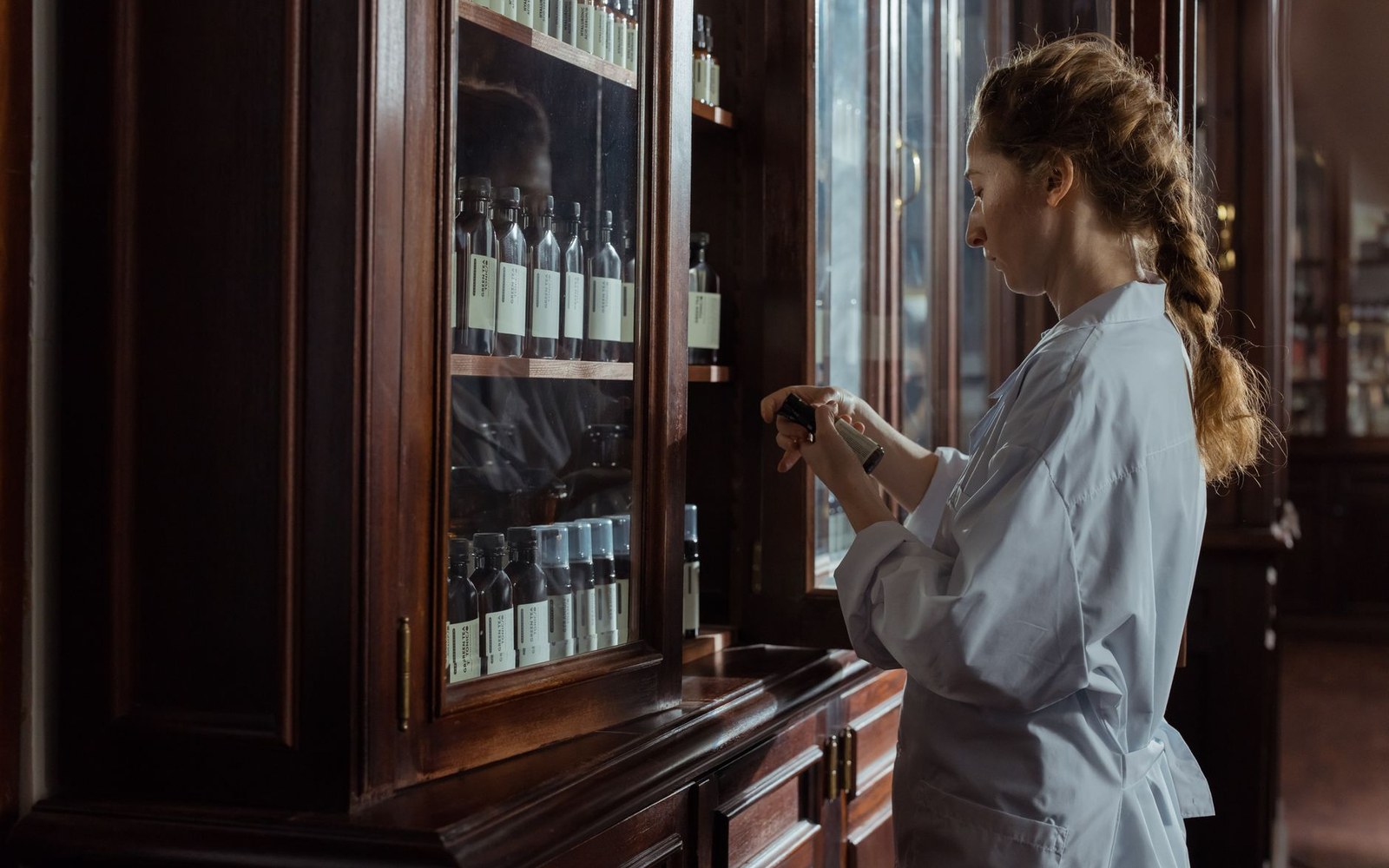
Labelled by remedy and by potency; what is inside each vial is sugar.Photo: cottonbro studio / Pexels
The finished object a buyer handles is a sugar pellet in a tube.Photo: Jess Loiterton / Pexels
The production sequence, step by step
A homeopathic preparation begins with a source substance — mineral, botanical or biological — reduced to a liquid extract called the mother tincture. The Homeopathic Pharmacopoeia of the United States ↗, the compendium that has governed American homeopathic manufacturing since 1897, specifies the proportion of plant material to alcohol solvent, the maceration period, and the minimum standards for each source category. The mother tincture is designated with the symbol Ø and carries the full concentration of the original substance; every subsequent preparation is derived from it.
Serial dilution and succussion
From the mother tincture, the manufacturer performs a serial dilution. On the centesimal scale — the most widely used, denoted by the letter C — one part of the tincture is added to ninety-nine parts of diluent (typically purified water and ethanol) to produce the 1C preparation. That preparation is then shaken vigorously, a step the Organon calls succussion, before the next dilution begins. One part of 1C is taken into ninety-nine parts of fresh diluent to produce 2C, and the process repeats. At each stage the vial is succussed; that shaking step, not the dilution alone, is held in homeopathic theory to produce what practitioners call potency.

Sixty zeros, written out.Photo: https://kaboompics.com/ / Pexels
The arithmetic compounds quickly. By 12C the dilution factor reaches 10⁻²⁴, a threshold near Avogadro's number — the constant 6.022 × 10²³ — beyond which no molecule of the original solute is statistically likely to remain. Preparations sold commercially commonly run to 30C, a factor of 10⁻⁶⁰. The HPUS acknowledges these dilution levels without making mechanistic claims about what, if anything, remains chemically active.
The pillule as final carrier
The liquid preparation at the chosen potency is then applied to small tablets of lactose or sucrose — the pillule — which absorb it and are allowed to dry. The pillule is the dosage form the patient handles; the active constituent, if present at all, is in the liquid absorbed into its surface. HPUS monographs specify the ratio of liquid to lactose granule mass and the standards for drying. Globules, tablets and liquid drops are all recognised carrier forms, but the pillule remains the form most commonly encountered in retail product.
The sequence — source material, mother tincture, serial dilution with succussion, transfer to solid carrier — is consistent across pharmacopoeias, and it is this sequence that determines what the dilution arithmetic describes.
The material behind this piece
- Mother tincture (Ø)starting liquid extract at full source concentration
- 1Cone part tincture in ninety-nine parts diluent, succussed
- 12Cdilution factor ~10⁻²⁴; Avogadro threshold approached
- 30Cdilution factor 10⁻⁶⁰; the common retail potency
- Pillulelactose or sucrose tablet onto which the final liquid is absorbed