The European Academies Science Advisory Council, 2017
EASAC's 2017 statement on homeopathic products — the member academies who endorsed it, its scope, and the specific regulatory recommendations it directed at EU institutions.
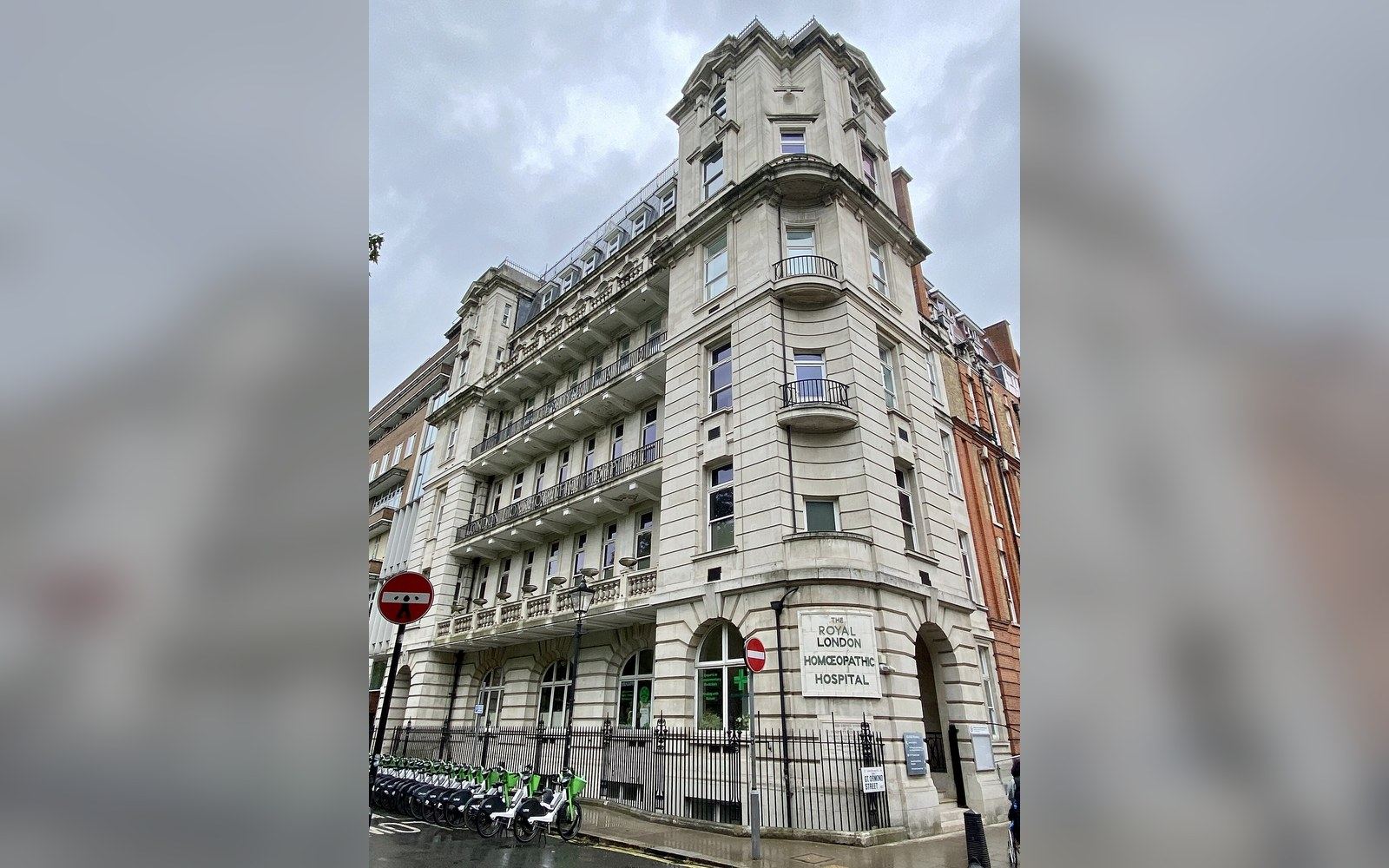
Great Ormond Street. The building kept its function and changed its name in 2010.Photo: Royal London Homoeopathic Hospital, Great Ormond Street, Bloomsbury, May 2024 · Wikimedia Commons

Endorsed by the member academies, and addressed to EU institutions.Photo: Werner Pfennig / Pexels
A body of national academies, one collective statement
In September 2017 the European Academies Science Advisory Council — EASAC — published a policy report titled Homeopathic Products and Practices: Assessing the Evidence and Ensuring Consistency in Regulation in the EU. EASAC is the joint body through which the national science academies of European Union member states, together with several associated academies, advise EU institutions collectively. The 2017 statement was endorsed by academies from across the EU, including those of Germany, France, the United Kingdom, and the Netherlands, giving the document a reach unusual for a single national review.
The report's starting point was arithmetical before it was regulatory. It noted that homeopathic preparations diluted beyond Avogadro's number — the constant 6.022 × 10²³ — cannot contain a single molecule of the original source material, and that no reproducible laboratory mechanism had been identified to account for any biological effect. That finding underpinned every regulatory recommendation that followed.

The conclusions section, where a review states its own finding rather than a summary of it.Photo: MART PRODUCTION / Pexels
EASAC reviewed the published trial literature and concluded that the claimed effects of homeopathic products were not demonstrably different from placebo effects. The council found no good-quality evidence supporting efficacy for any health condition, and noted that systematic reviews — including Aijing Shang et al.'s 2005 meta-analysis in The Lancet — had reached consistent conclusions to the same effect when higher-quality studies were isolated.
- 1811Avogadro proposes his molecular hypothesis
- 2001EU Directive 2001/83/EC establishes simplified registration pathway for homeopathic products
- 2005Shang et al. meta-analysis published in The Lancet
- September 2017EASAC publishes its statement on homeopathic products and practices
- 2018NHS England ends routine prescribing of homeopathic products
The recommendations directed at EU institutions were specific. EASAC called on the European Commission and the European Parliament to require that homeopathic products meet the same standards of evidence for efficacy and safety as any other medicinal product before receiving marketing authorisation. It recommended removal of the simplified registration pathway — the one that allows homeopathic products to be marketed without clinical evidence of effect under Directive 2001/83/EC — and it asked that product labelling be required to state clearly that no clinical evidence of efficacy exists. Advertising claims that went beyond what the evidence supported, EASAC argued, should be subject to enforcement action by national regulators.
The report also raised a patient-safety concern distinct from efficacy: that individuals might forgo evidence-based treatment in favour of homeopathic products, particularly for serious conditions. EASAC described this as a harm that regulatory frameworks should address directly, not only through labelling.
The full statement is available through EASAC's own publication record ↗, and its conclusions have been cited in subsequent national policy processes, including the NHS England decision to end routine prescribing of homeopathic products on the health service in 2018.